Growth
Ideal Customer Profile: Why It Matters for Every Growing Business
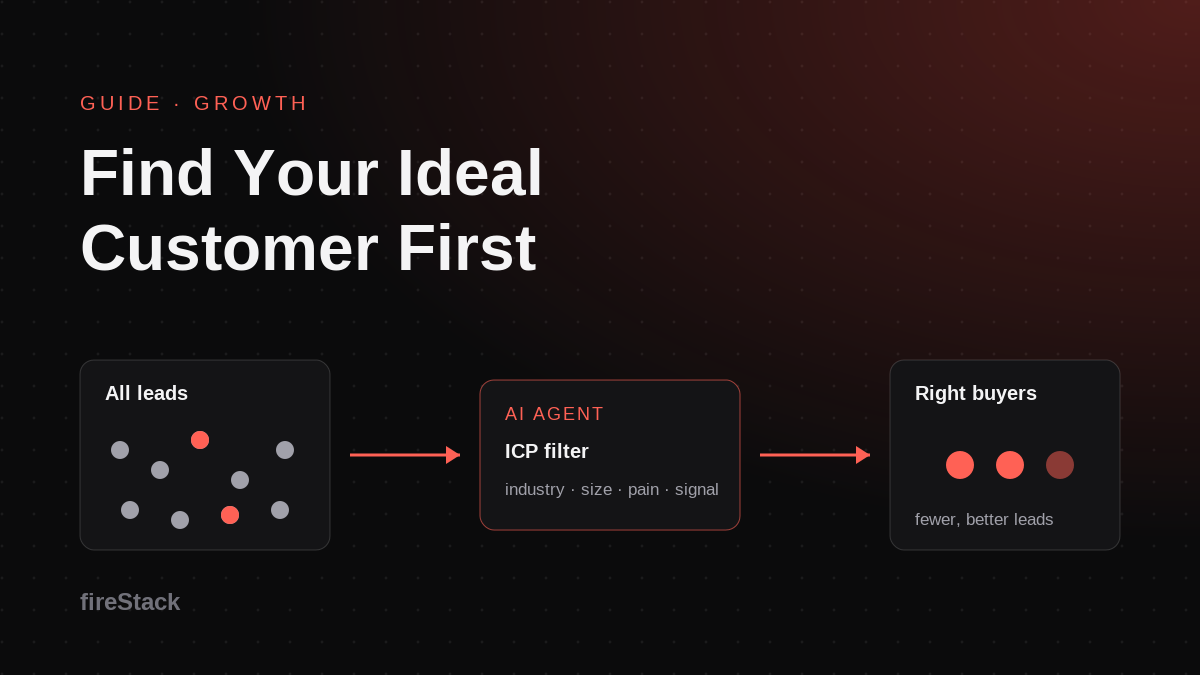
Most businesses do not have a lead problem. They have a fit problem. The pipeline looks busy, the sales team is on calls all week, and yet very little closes, because a large share of those leads were never going to buy in the first place.
The fix is not more leads. It is knowing exactly who your ideal customer is, and then pointing every campaign, message and follow-up at those people only.
What an ideal customer profile actually is
An ideal customer profile (ICP) is a precise description of the type of business or person that gets the most value from what you sell, and is most likely to pay for it, stay, and refer others.
It is not a vague persona like "growing SMBs" or "tech-savvy millennials". A useful ICP is specific enough that anyone on your team, looking at a lead, can tell straight away whether it fits.
A strong ICP usually answers questions like these:
- Who are they? The industry, niche and size of business, or for consumer brands, the life stage and location of the buyer.
- What problem do they have? The specific pain that makes them look for a solution like yours.
- Why now? The signals that show they are ready to buy, such as expanding, hiring, launching something new or outgrowing their current tools.
- Who decides? The person who feels the problem and the person who signs off on the purchase.
When you can answer these clearly, you stop selling to a crowd and start selling to a buyer.
Why skipping this step costs you money
When a business has no clear ICP, the same pattern shows up again and again.
Ad spend goes to the wrong audience. Broad targeting brings clicks, but clicks from people who cannot afford you, do not need you, or are just browsing.
Sales time is spent on dead ends. Every call with a poor-fit lead is time not spent with someone who could actually buy. For a small team, that is the most expensive leak of all.
Messaging becomes generic. If you are talking to everyone, you cannot speak to anyone's real problem, so your message ends up bland and easy to ignore.
The wrong customers cost more to keep. Even when a bad-fit lead converts, they often need heavy support, push for discounts, and leave early. Revenue on paper, cost in practice.
You chase the wrong business options. Without a clear ICP it is easy to say yes to every partnership, marketplace or channel that comes along, and spread a small team across too many directions.
Here is how the two approaches compare in practice:
| Without an ICP | With a clear ICP | |
|---|---|---|
| Targeting | Broad audiences and guesswork | Specific businesses and people who match your profile |
| Lead volume | High | Lower, but relevant |
| Sales conversations | Many, mostly unqualified | Fewer, with real buying intent |
| Messaging | Generic benefits | Speaks directly to one known problem |
| Customer quality | Mixed, with higher churn risk | Customers who get value and stay |
| New channels and partnerships | Said yes to by default | Chosen by whether they reach your ideal buyer |
Knowing your ICP is only half the job
Most founders have a rough sense of who their best customers are. The difficulty is acting on it consistently.
Finding businesses or people who match your profile, checking whether they are a real fit, spotting the ones who are ready to buy now, and reaching them before a competitor does is slow, repetitive work. Done by hand, it either eats your team's week or quietly stops happening, and you drift back to chasing whoever shows up.
This is where AI and automation change the picture.
How Firestack helps you reach your ideal customers
At Firestack, we build AI-powered systems that find and target your ideal customers for you, so your team spends its time closing deals rather than sorting through the wrong leads.
Here is what that looks like for a business we work with:
- We define your ICP with you. We look at your best customers, your offer and your market, and turn that into a clear profile of who you should be selling to and who you should not.
- We build AI agents around your business. Every business is different, so the agents are customised to your industry, your market and your sales process rather than built from a generic template.
- The agents gather data on your ideal customers. They find prospects who match your profile and collect the information that matters, such as the type of business, its size, location, the right decision-maker and signals that they are ready to buy.
- Poor-fit leads are filtered out. Prospects who do not match your ICP are dropped before anyone on your team spends time on them.
- Only the right people are targeted. Your outreach and campaigns go directly to the audience that matches your profile, so the leads coming in are ones worth converting.
- The system keeps improving. As leads convert or fall away, the targeting is refined, so it gets sharper the longer it runs.
The outcome is not a flood of contacts. It is a steady flow of leads that look like your best customers, and a much better chance of turning them into paying ones.
We are also careful about where AI belongs. An agent pointed at a vague target will find vague leads faster, which is why we start with the profile, not the technology. We have written about why over-engineered AI hurts startups, and the same thinking applies here.
If you are curious how AI agents can help with the rest of your operations, see how businesses can run their dashboard by just asking.
The takeaway
Every lead you chase costs time and money. An ideal customer profile makes sure that cost is spent on people who can actually buy.
Knowing who your ideal customer is gives you focus. Having a system that finds and reaches those customers for you, every day, is what turns that focus into growth. That is what we build at Firestack.
Talk to us about building an AI system that finds your ideal customers.