AI Engineering
Too Much AI: Why Over-Engineered AI Is Killing Startup Software
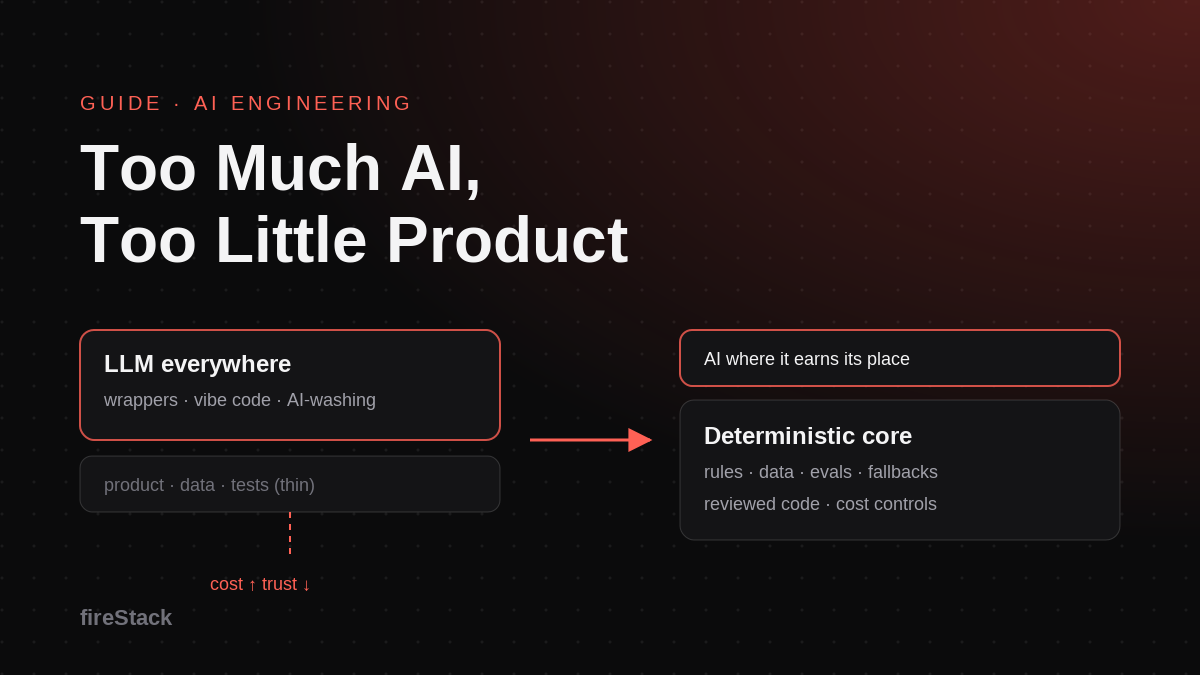
Most startups that die in the current AI wave are not killed by a lack of AI. They are killed by too much of it, in the wrong places: an LLM call where a database query would do, a codebase nobody on the team actually understands, and a pitch deck that promises intelligence the product does not have.
This post is for founders and CTOs who are deciding how much AI to put into their software. The short version: AI is a component, not a strategy, and the startups treating it as a strategy are the ones showing up in shutdown lists.
The evidence is piling up
The failure rate is no longer anecdotal.
- MIT's NANDA initiative studied 300 public AI deployments, interviewed 150 leaders and surveyed 350 employees for its GenAI Divide report (2025). It found that only about 5% of generative AI pilots delivered rapid revenue growth; the rest stalled with little measurable impact. The researchers blamed poor integration into real workflows, not model quality.
- Veracode's 2025 GenAI Code Security Report tested more than 100 LLMs on 80 coding tasks. The generated code introduced OWASP Top 10 vulnerabilities in 45% of cases, and security performance did not improve with newer models.
- Builder.ai, once valued at about $1.5 billion and backed by Microsoft, entered insolvency in May 2025 after its revenue was reported to be inflated by as much as 300% and a creditor seized $37 million from its accounts. It was also accused of marketing as "AI" work that was largely done by human engineers.
- Relay, an AI workflow-automation tool positioned as a Zapier alternative, shut down in August 2026 after five years, as OpenAI, Google and others built similar capabilities straight into their own products.
These are different failures, but they share a root cause: AI was placed at the centre of the business before anyone asked whether it belonged there.
Failure mode 1: AI as the product, with nothing underneath
The most common pattern is the thin wrapper: a prompt, a UI and a subscription page on top of someone else's model.
It demos beautifully. The problem is that your entire product is now a feature on your model provider's roadmap. When the platform ships the same thing for free inside a tool your customers already use, you have no data, no workflow and no distribution to fall back on. That is exactly what happened to Relay, and to a long tail of "AI assistant for X" startups.
A defensible AI product owns something the model does not: proprietary data, a painful workflow end to end, or a distribution channel. If you remove the LLM and nothing valuable remains, you do not have a company yet.
Failure mode 2: AI where plain code would do
The quieter killer is architectural. Teams reach for an LLM because it is the newest tool, not because the problem needs it.
Here is a real pattern we see in audits. A support system routes tickets by asking a model to classify every message:
// Every ticket costs an API call, adds 1-3 s of latency,
// and can return a different answer for the same input.
const category = await llm.complete(
  `Classify this ticket as billing, bug or other:\n${ticket.body}`
);
Most of those tickets could be routed deterministically, with the model kept for the genuinely ambiguous ones:
const RULES: Array<[RegExp, Category]> = [
  [/\b(refund|invoice|charged|payment)\b/i, "billing"],
  [/\b(error|crash|500|not loading|broken)\b/i, "bug"],
];

function classify(body: string): Category | null {
  for (const [pattern, category] of RULES) {
    if (pattern.test(body)) return category;
  }
  return null; // ambiguous: let the model decide
}

const category = classify(ticket.body) ?? (await llmClassify(ticket.body));
The second version is cheaper, faster, testable and gives the same answer twice. The model still earns its place, but only on the cases that need judgement.
Multiply the first pattern across search, validation, recommendations and notifications, and you get a product with unpredictable behaviour, an inference bill that grows faster than revenue, and outages every time your provider has a bad day. Unit economics that only work at seed-stage volumes are a slow-motion shutdown.
Failure mode 3: the vibe-coded codebase
AI coding assistants are excellent accelerators for engineers who can read and judge what they produce. They are a liability when they replace that judgement.
The typical story: a small team ships an MVP in weeks by accepting generated code wholesale. Six months later nobody can explain how authentication works, every change breaks something unrelated, and a security review turns up injection and cross-site scripting holes. Veracode's numbers suggest that is not bad luck; it is the expected outcome when generated code goes to production unreviewed.
Technical debt used to accumulate over years. With unreviewed AI output, a startup can build up years of it in a quarter, right before the moment it needs to scale or pass an enterprise customer's security questionnaire.
Failure mode 4: AI-washing the pitch
Builder.ai is the extreme case, but milder versions are everywhere: "AI-powered" on a landing page for features that are rules engines or manual operations.
The short-term reward is real; AI labels help raise money. The long-term cost is that you are now selling a capability you have to keep pretending to have. Customers notice when the "AI" needs a week and a human. Investors notice in due diligence. Trust, once lost, does not come back with a better prompt.
Where AI belongs, and where it does not
A simple test before adding a model to any feature:
| Question | If yes | If no |
|---|---|---|
| Is the input unstructured (free text, images, audio)? | AI may fit | Use code or a query |
| Is an occasional wrong answer acceptable or reviewable? | AI may fit | Use deterministic logic |
| Can you measure quality with a test set? | Ship it with evals | Do not ship it yet |
| Does the feature still work if the provider is down? | Good design | Add a fallback first |
| Does the per-request cost fit your pricing at 10x volume? | Viable | Cache, batch or reconsider |
MIT's research points the same way: the projects that succeed tend to pick one pain point, integrate it properly into a workflow, and measure the result. Back-office automation, not flashy front-end features, showed the clearest return.
How to use AI without letting it sink you
- Start from the problem, not the model. Write down what the user is trying to do. Add AI only to the step that genuinely needs language understanding or generation.
- Keep a deterministic core. Business rules, permissions, pricing and data integrity live in code you can test. The model sits at the edges.
- Review every line of generated code. Treat assistant output like a pull request from a fast, confident junior: useful, and never merged unread. Run static analysis and dependency scanning in CI.
- Build evals before features. If you cannot say how often the AI feature is right, you cannot tell whether a model upgrade made it better or worse.
- Budget inference like infrastructure. Track cost per user and per request from day one. Use caching and smaller models where they are good enough. Our post on caching covers the basics.
- Design for provider failure. Timeouts, retries and a sensible fallback path mean a model outage degrades one feature instead of taking down the product.
- Be honest about what is automated. Human-in-the-loop is a perfectly good product. Hiding it is what turns an operational choice into a scandal.
If you are adding retrieval or a chat layer, our guides to shipping LLMs safely and RAG pipelines go deeper on the engineering.
The takeaway
AI is not what is sinking these startups. Using AI as a substitute for a product, an architecture, an engineering team or an honest pitch is.
The companies that last use models the way they use databases and queues: as components chosen for a specific job, with tests, cost controls and fallbacks around them. Put AI where it earns its place, keep everything else boring and reliable, and you will be building the product your competitors' wrappers are about to be replaced by.
Talk to us if you want a second opinion on where AI fits in your product, or an audit of an AI-heavy codebase before it becomes a problem.
Sources: MIT NANDA, The GenAI Divide (via Fortune) · Veracode 2025 GenAI Code Security Report · TechCrunch, The AI graveyard · TechInformed on Builder.ai